The Complete Guide to Sorano, Tuscany
What Sorano is, how to reach it, what to see and do, where to eat, and when to go. A practical guide from people who live here, not people who visited once.
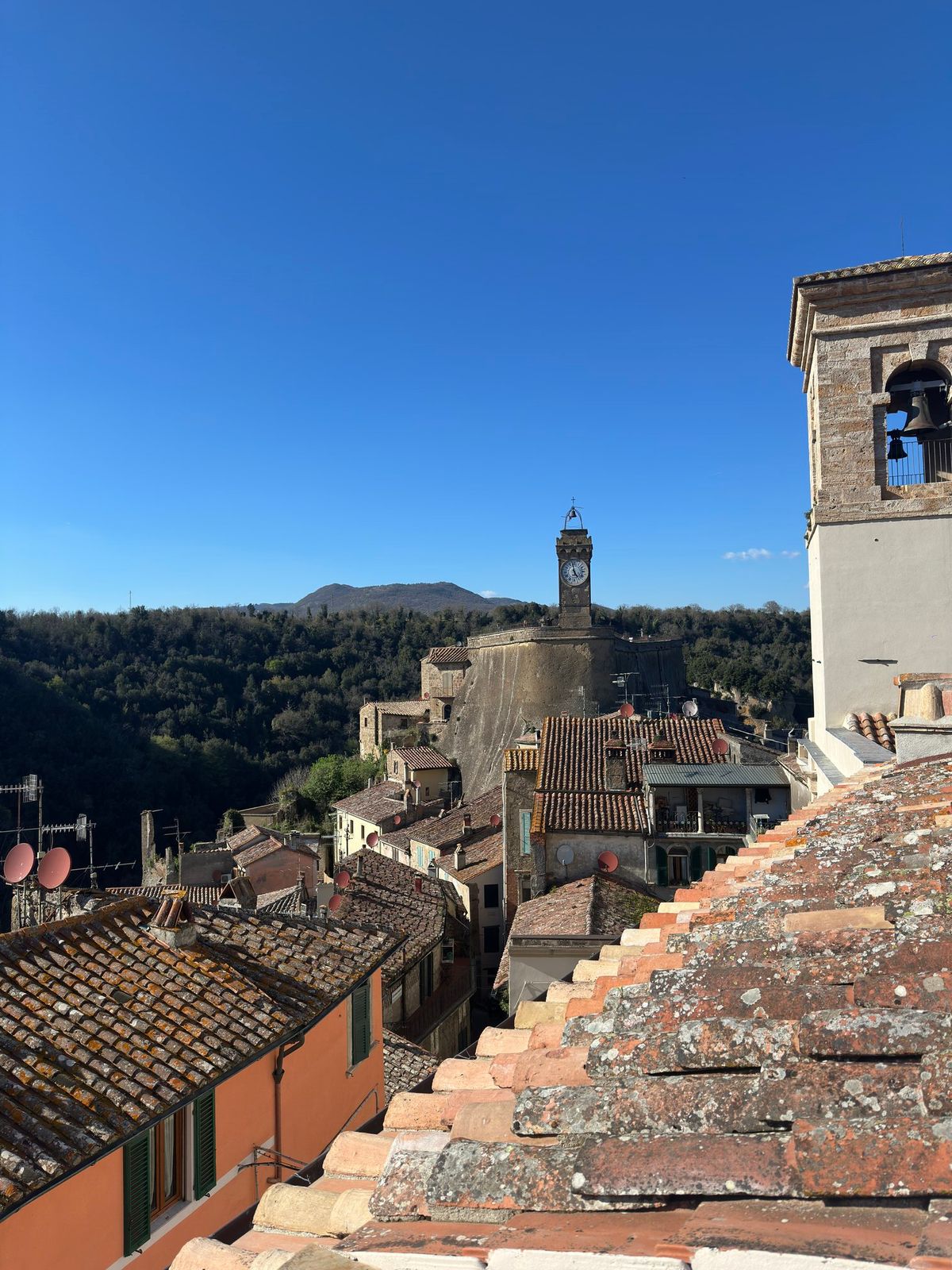
Sorano is a village of about 3,000 people in the southern Maremma, built into a cliff of volcanic tuff above the Lente river. It sits roughly midway between Rome and Florence, close to the Etruscan towns of Pitigliano and Sovana. Most visitors to the area stop in Pitigliano. Sorano is the one they wish they had spent more time in.
This guide covers what Sorano actually is, how to reach it, what to see and do, where to eat, and when to go. It is written by people who live here, not people who visited once.
What is Sorano?
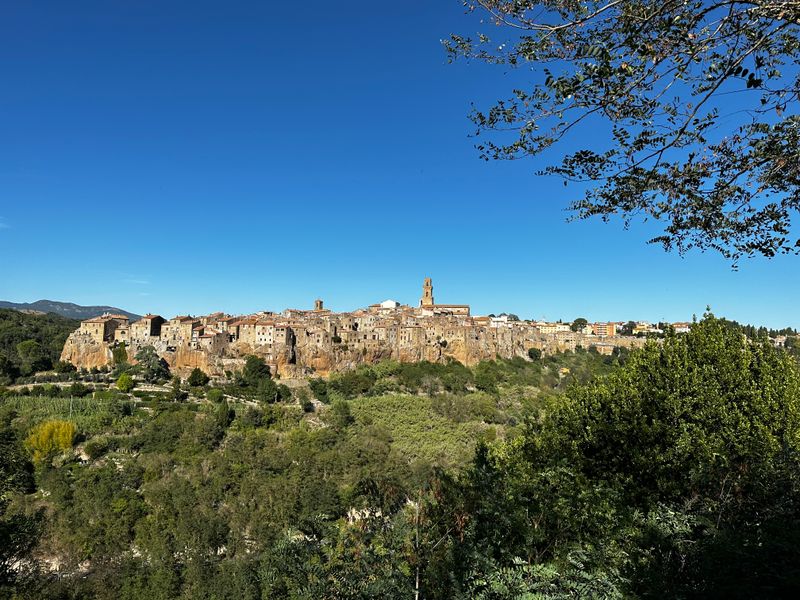
Sorano belongs to a group of villages in the province of Grosseto built from, and into, volcanic tuff. The same soft stone that forms the cliffs forms the buildings. The medieval town centre sits at roughly 400 metres above sea level on a narrow ridge, with the Lente gorge on one side and steep terraced hillsides on the other.
The Etruscans were here before the Romans. The tuff cliffs around Sorano are riddled with their tombs, and the countryside is crossed by the Vie Cave: ancient sunken roads carved into the rock, some of them over twenty metres deep. Medieval towers and fortresses were built on top of the Etruscan foundations. The current village centre has not changed dramatically in appearance since the 16th century.
Sorano was listed as one of Italy's most beautiful villages in 2023, a designation held by a small number of historic settlements across the country. It also carries the Touring Club's Orange Flag, awarded to smaller towns for quality of cultural heritage and visitor experience.
The population is approximately 3,000 across the municipality. In the old hilltop centre, the number of year-round residents is much smaller. You will notice that.
Getting to Sorano
By car is the only practical way.
From Florence: take the A1 south toward Rome, exit at Chiusi-Chianciano Terme, then follow the SP478 and SS74 toward Manciano and Sorano. The drive is approximately 2 hours and 15 minutes, covering around 180 kilometres. The final stretch of road through the hills is slow and winding.
From Rome: take the A1 north, exit at Orvieto, then follow signs toward Sorano via the SP19. The distance is approximately 155 kilometres. Allow around 2.5 to 3 hours including the exit roads.
From Grosseto: follow the SS74 eastward. The drive is roughly 55 kilometres and takes about one hour.
There is no train station in Sorano. The nearest stations are Albinia (approximately 55 kilometres) and Orvieto (approximately 60 kilometres). From Albinia, local Tiemme buses serve the area, but schedules are infrequent and connections to the village require planning. If you are arriving by train, hiring a car at your arrival city is the most reliable approach.
A car is also useful once you are here. Pitigliano, Sovana, Saturnia, and the Vie Cave trailheads are all reachable in 15 to 35 minutes. Without a car, you are limited to what is within walking distance of the village.
For more, see our dedicated post on how to get to Sorano.
What to do in Sorano
The Orsini Fortress
The Orsini family controlled this part of Tuscany from the 13th century, and the fortress they built above Sorano is the most significant structure in the village. It now houses the Civic Archaeological Museum, with finds from Etruscan and Roman sites across the area.
Entry costs €5 (full price) or €3.50 (reduced). A combined ticket at €10 covers the Orsini Fortress, the Etruscan Necropolis of Sovana, the Museum of San Gregorio VII, and the Archaeological Museum of San Mamiliano — all the main sites across the Città del Tufo area. If you are spending more than a day here, the combined ticket is the better value. Hours vary by season; check museidimaremma.it or call 0564 633767 before your visit. A visit to the fortress alone takes about an hour.
The Masso Leopoldino
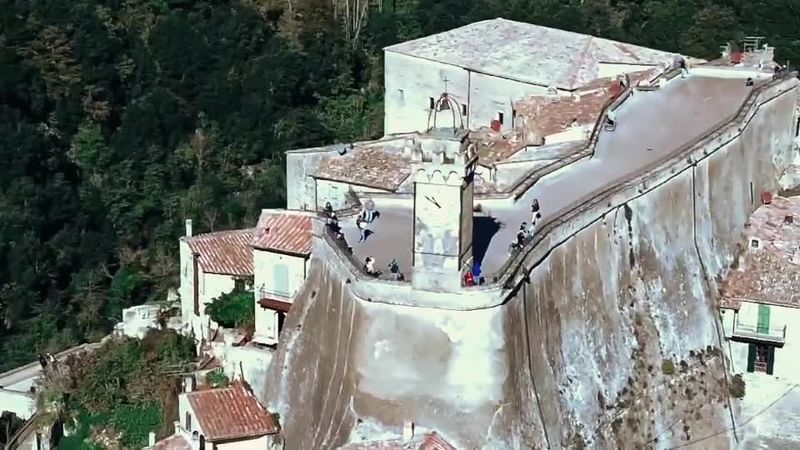
This is the tuff promontory that the old village is built around and onto. In the early 19th century, Grand Dukes Ferdinando III and Leopoldo II commissioned stabilisation works on the rock face, smoothing and consolidating the cliff to prevent collapse. The project gave the rock its name.
At the top, there is a panoramic terrace accessible by a steep flight of steps. It costs nothing to visit. From the terrace you can see the village below, the Lente gorge, and the surrounding Maremma hills. It is, on a clear day, one of the better viewpoints in southern Tuscany.
The Collegiata di San Nicola
The main church of Sorano stands in Via Santa Monica, in the upper part of the historic centre. It is first recorded in documents from 1276, received the title of collegiate church in 1509, and was substantially rebuilt in the 18th century. The current interior is largely from that period, though the rear of the building still shows traces of the earlier Romanesque structure.
Inside, the church holds a 16th-century travertine baptismal font and a collection of paintings and liturgical objects spanning from the late Middle Ages to the 19th century. It is not a major museum, but it is the oldest functioning building in the village and worth a few minutes when you are walking through the centre.
Entry is free.
The Vie Cave
The Vie Cave are Etruscan roads carved into the tuff rock. They run between Sorano, Pitigliano, and Sovana as a network of sunken paths, some of them up to twenty-five metres deep and several hundred metres long. Historians are still not fully agreed on their purpose. They may have been trade routes, ceremonial paths, defensive structures, or all of these.
The Via Cava di San Rocco begins at the edge of Sorano and is the most accessible starting point for walking into the network. The full route connecting all three towns is approximately 7 kilometres and takes 6 to 7 hours on foot, with medium difficulty. Red and white trail markers guide the route.
Spring and autumn are the best seasons for walking the paths. In August, the narrow canyon walls trap heat. After heavy rain in winter, the stone becomes slippery.
Pitigliano and Sovana
Pitigliano is 5 kilometres from Sorano, roughly 10 minutes by car. Sovana is 10 kilometres away, around 15 minutes. Each is distinct from Sorano and from each other. We cover them in detail in our guide to the three tuff towns.
Terme di Saturnia
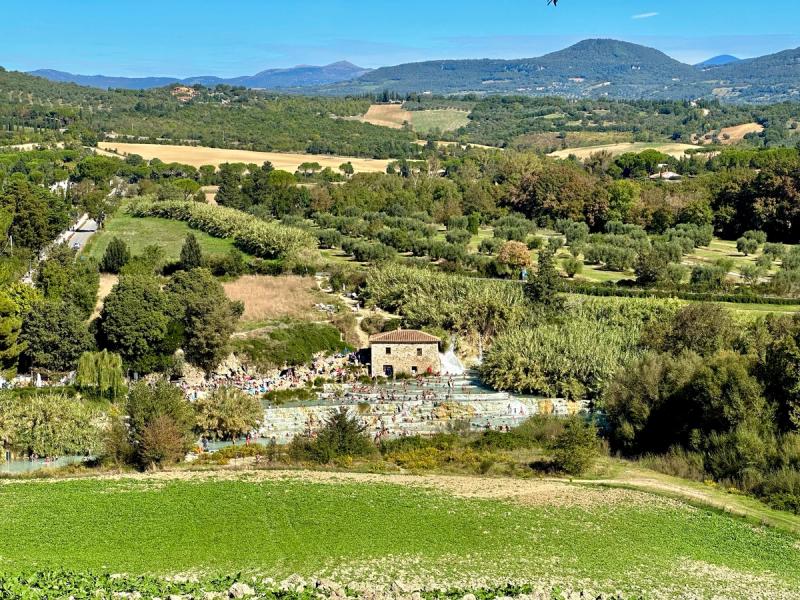
The thermal springs at Saturnia are 35 minutes from Sorano by car. The free pools, the Cascate del Mulino, are natural travertine waterfalls with water at a constant 37.5°C, open 24 hours a day at no charge. They are one of the more unusual things you can do in Tuscany. For a full practical guide, see our post on Saturnia.
Terme di Sorano
Sorano has its own thermal baths, a short distance from the village centre. The water comes out of the ground at 37°C, the same volcanic source as Saturnia, and the facilities here are more organised: a large covered thermal pool, a sports pool open in summer, a wellness centre, and a restaurant. It also operates a small residence for overnight stays.
Entry from Monday to Friday costs €20 (low season) or €22 (high season), with a sun lounger included. Weekend and public holiday rates are €22 or €24. Children under 14 pay €10.50. A parasol costs €4 extra. Opening hours are 10:00 to 19:00 from April through October, and 10:00 to 18:00 from November through March.
For those who want thermal water with facilities rather than the wilder setting of Saturnia's free pools, Terme di Sorano is the practical choice. It is also less crowded, which counts for something in peak season.
The Argentario coast
The Argentario peninsula and Orbetello lagoon are about an hour south of Sorano by car. The peninsula has two main towns, Porto Ercole and Porto Santo Stefano, and several beaches accessible from the main road. It is a different pace and landscape from the inland Maremma, and worth combining with a longer stay.
Where to eat in Sorano
Mario has eaten at these places his whole life. That counts for more than a TripAdvisor ranking.
Fidalma has been in Piazza Busatti since 1965, always run by the same family. The menu is traditional Soranese: pici pasta with Cinta Senese white ragù, lamb stew, wild boar with olives, and seasonal antipasti based on what is available locally. In June 2025, the restaurant returned to direct family management after a brief period under external ownership. Open Monday, Tuesday and Thursday to Sunday, 12:00 to 14:30 and 19:00 to 21:30. Closed Wednesday.
Cantina L'Ottava Rima, on Via del Borgo, is built into an Etruscan cave in the lower part of the village. The kitchen sources ingredients from within 60 kilometres, the wine list focuses on the Tuscan Maremma, and the room itself is worth the visit. It functions as both a wine bar and a full restaurant.
Hosteria del Borgo, at Via del Borgo 44, sits at the edge of the village with a terrace overlooking the Lente gorge. The menu is Tuscan: ricotta tortelli, pici with wild boar, grilled meats. Open Tuesday to Sunday for lunch and dinner.
All three are small. In summer, booking ahead is advisable.
When to visit
May and June are the most consistently good months. Temperatures are between 20 and 25°C, the countryside is green, the tourist numbers are manageable, and all restaurants and attractions are open.
September and October are the other reliable window. The heat has gone, the harvest is underway in the surrounding vineyards and olive groves, and the Vie Cave are at their most atmospheric with the autumn light. September in particular combines good weather with noticeably fewer visitors than summer.
August is the hottest month, with daytime temperatures regularly above 30°C. The Vie Cave become uncomfortable to walk in the midday heat. Parts of the village empty as local residents leave on holiday, and some restaurants close for part of the month. Some travellers prefer the pace. The village is still there, the Masso Leopoldino still has the same view. Go knowing what to expect.
Winter is cold and quiet. January highs average around 10°C. Some restaurants and local services reduce their hours or close. If you are coming in winter, confirm opening times in advance.
Where to stay in Sorano
The village has a small number of accommodation options. Hotel della Fortezza is the best-known, occupying part of the medieval fortress complex. Several agriturismos operate in the surrounding countryside.
Staying within the old village, rather than outside it, makes a difference. The narrow streets at night, with most of the day visitors gone, are a different experience from the daytime.
Palazzo Palloni is a historic palazzo in the upper village, with two restored apartments: the Boutique Apartment for couples and Piano Nobile for groups of up to six. Both have been in the same family for generations. Mario, a retired architect, will meet you at the door.
Staying in Sorano? We would be glad to have you at Palazzo Palloni. [Book direct and save 20%.](/book-direct)